Monday, 8 February 2016

Ex-Mortgages PLC boss sets up new lender

House-Home-Property-Ladder-Mortgage-700x450.jpg

Former Mortgages PLC chief executive David Pothecary is setting up a new company called The Mortgage Lender with several former colleagues.


The new company will be a specialist lender.


The Bristol-based firm has not officially launched, but Companies House documents confirm that Pothecary, currently chairman at RPS Capital Partners, is its principal.


The Mortgage Lender has four directors: Pothecary, former Mortgages PLC operations director Hugh Meechan, P&S Thomson Consultancy director Peter Thomson and The Business Lender director Alex Cameron.


Trevor Pothecary is the main shareholder in The Mortgage Lender, followed by Maureen Pothecary. The two own 600,000 of the firm's 975,000 shares between them.


Other shareholders include Meechan, Thomson and Cameron, as well as Pothecary's former Mortgages PLC colleagues Scott Callaghan, David Newman, Ailsa Smith, Stephen Crawford, Claire Duncan and Susan McCallum.


Further shareholders include Tom Tredwell, who works alongside Pothecary and Newman at RPS, and Derek Brown.


Mortgages PLC was sold to Japanese-financed Majestic Acquisitions in January 2002 in a deal thought to be worth close to ?40m.


Majestic then sold its stake in Mortgages PLC to investment bank Merill Lynch in November 2004.


Pothecary did not respond to requests for comment.

Saturday, 6 February 2016

Think-tank: Govt should ignore flat rate and abolish tax free cash

Tax-Taxation-Blocks-700.jpg

George Osborne should resist moving to a "misguided" flat rate of pension tax relief and instead cut or abolish tax free cash, an influential think-tanks says.


In recent weeks it has emerged the Treasury's preferred option for a new system is the flat rate of relief championed by much of the industry.


But the Institute of Economic Affairs says a flat rate would be "incredibly complex" and detach pensions taxation from "any reasonable economic principles".


It says the current system has a sound logic as those on high incomes receive more relief because they pay more tax over their lifetimes.


The think-tank adds HMRC would need to introduce new complicated rules to stop employees working around a flat rate.


It favours retaining both the annual and lifetime allowance but removing the 25 per cent tax-free lump.


It says: "The tax-free lump sum allows contributions to sidestep the tax system completely - in effect creating an EEE regime for that quarter of the pension pot. This then necessitates a huge volume of tax regulation to prevent perceived abuse."


Lowering or abolishing the lump sum would "hugely reduce the 'benefits' that flow to the rich from tax relief", the IEA says.


It also takes aim at pension Isa champion Centre for Policy Studies' Michael Johnson and others' assertions of the cost of tax relief. It says highlighting the gross cost of tax relief is "totally wrong".


It says: "The reports of the costs of pension tax relief we often hear about are not judged against sensible counterfactuals and vastly overstate the cost relative to a neutral system of taxation."

Friday, 5 February 2016

Goldman Sachs insurer eyes Aegon annuity book

Aegon-Logo-Building-2012-700x450.jpg

Pension insurer Rothesay Life is in advanced talks to buy an ?8bn annuity book from Aegon.


Sky News reports the insurer - owned by Goldman Sachs - has entered exclusive talks to purchase the annuity assets from Dutch-owned Aegon.


In September 2015 an internal memo responding to speculation the whole firm was for sale reaffirmed the provider's commitment to the UK but revealed it was reviewing its annuity portfolio.


The memo said: "We have built a market leading platform which continues to be the fastest growing platform both by percentage and in terms of asset growth.


"We have clear differentiation in our proposition "to and through" retirement and this is supported by innovative products such as Secure Retirement Income which is the only guaranteed product available on platform today.


"We will continue to grow our platform both organically and through acquisition."


Last week, Money Marketing revealed Aegon has reached a verbal agreement with Legal & General to buy its platform Cofunds. Around 30 sales staff working on its legacy business are also expected to leave as part of a restructuring of resources towards its platform division.


Rothesay Life declined to comment.

Thursday, 4 February 2016

Phil Young: Under the FCA's all-seeing eye

Phil-Young-700x450.jpg

The concept of the panopticon – a prison with a single watchtower where inmates do not know if and when they are watched so must always assume they are – was adopted by French thinker Michel Foucault to explain how all relationships of power function.


Imagery aside, this is not necessarily a bad thing. Maintaining even the most basic form of social order requires us to assume we act and think under the gaze of some greater authority: if not God, then the Government, the police, a schoolteacher or our parents. Somewhat unwittingly, the FCA has become the panopticon for financial advisers. Not simply as a regulator but in terms of how advisers acquire their own subjectivity, which is far more interesting.


A couple of years back, an adviser summed this up perfectly when he said to me: “I’ve accepted that I run a franchise of the FCA. I own the business but pay it a fee for my licence and it controls how I market myself, how I charge and how I advise.”


Advice has always been shaped by something other than advisers. When I started out, firms were still moving from FIMBRA to PIA and it was life companies that fulfilled the role of panopticon, handing out jobs and training via its sales force, then a business model with commission and punishment through clawback. When the role of the life company dwindled, it was platforms and fund managers that handed advisers a replacement business model and charging structure in the form of ad valorem charging.


The move from PIA to FSA, which culminated in the RDR, cemented the position of the regulator as panopticon, defining what good and bad advice would look like, and what good and bad advisers looked like. This has been achieved despite a reduction in the amount of direct contact a small advice firm will have with the regulator. Examples of how it has been achieved with so few foot soldiers are as follows:


Requests for information: We have no real understanding about what happens to the huge amounts of information sent to the FCA by all parts of the industry. We suspect it cannot all be used or acted on but have no idea which parts in particular or when it is ignored.


Good and bad practice: Messrs Findlay, Gould and Percival are excellent presenters. Rory is now the single biggest draw as a speaker for any adviser event, including paid-for events, not just FCA ones. There is also constant demand for more guidance, and good and bad practice examples. Advisers are willingly defined by the FCA and want more instruction.


Interim levies: Like a thunderbolt from Zeus, interim Financial Services Compensation Scheme levies are received by advisers as severe, unpredictable and unjust. A reminder that nobody is invisible and everyone can be called to account at any time.


Information on fines: A steady stream of information about fines and bans comes direct from the regulator and is spread via the trade press.


I do not think for a second any of this was intended. Percival himself was quoted saying he would prefer advisers to think about doing the right thing by their clients instead of worrying about what the regulator thought. However, this is extremely difficult if advisers derive much of their identity from the FCA, not simply their regulatory licence. What would stand in its place?


Advisory businesses are typically small, so there is little competition for the FCA as panopticon. Less so for large financial institutions such as banks, insurance companies and asset managers. Senior management at big businesses all work under the gaze of the share price, which is the sole judge of their abilities. Moving the share price upwards is the only true objective and bonuses are paid in shares. Roles are sufficiently specialised and compartmentalised to provide for dedicated risk personnel to deal with the regulator, so that others can work without the distraction of operating under the regulatory gaze. In this context, the FCA can lose its day-to-day power over senior management, which is limited to occasional set-piece meetings. Perhaps this is the ‘culture’ that concerns regulators: too much dependency from advisers, too little from institutions?


Questions are being asked on what we as a country want the regulatory remit to be, its function and purpose, and what budgetary constraints it should operate within. Rumours about a lack of independence and clear direction without a chief executive weaken its position and need to be addressed.


The FCA’s modern role as setter, rather than regulator, of culture among adviser firms may be too subtle to be noticed. If its role or reputation is diminished further, so too might its effectiveness be.


Phil Young is managing director at Threesixty

Wednesday, 3 February 2016

Keith Richards: When is commission not commission?

Richards-Keith-700x450

The advice profession has evolved post-RDR and continues to gain positive recognition for the key role it plays. As a professional body we would not be in favour of a return to commission of old and this view is clearly shared by many across the advice sector. I equally doubt commission would appeal to most providers, given how capital intense and uneconomical it was.


So why, all of a sudden, is it back on the agenda? Have we simply misinterpreted the FCA’s recent comments on the matter and the key underlying reason why it is open to consider advice fee options?


Three years after RDR forced a change to fee-based advice (or, to be more specific, abolished the factoring of commission into investment products) it is permissible for transparent adviser fees to be facilitated via the provider or platform as a client option.


So why is it that the Financial Advice Market Review is giving rise to speculation that some form of commission may be reintroduced? Quite simply, it is not. However, the FCA is open to exploring options to recover a transparent advice fee from regular premiums, in particular for consumers who want to save but may be put off seeking advice because of up-front fees.


In order to best serve the interests of a wider segment of consumers, the review is considering the introduction of a lower cost, “simplified” regulated advice solution, which will also include the option for advice fees to be recovered over an agreed period of time from the premium – possibly called a “client agreed advice fee”.


Vertically integrated firms are already well-placed to operate such a system in a post-RDR environment, as recovery is easier to administer, but development to improve consumer options and access should be open to all models.


The inclusion of transparent CAAF would increase the options available for the public to pay for advice, reduce barriers to engagement and be capable of working equally well for full advice. More importantly, it can be implemented today, does not conflict with RDR Conduct of Business rules and would not therefore be commission.


Keith Richards is chief executive of the Personal Finance Society

Tuesday, 2 February 2016

Tony Wickenden: Key pension changes from the 2016 Finance Bill

Tony Wickenden 620x430

And so, in my journey through the sometimes arid landscape of the draft clauses for the Finance Bill 2016 most relevant to financial planners, we arrive at the oasis of pensions. As in my previous articles in this series, I will break my consideration down into the headings used in the HM Revenue & Customs overview of the draft legislation for consultation.


Pensions


Lifetime allowance


As announced and confirmed in last year’s Budgets, legislation will be introduced in the Finance Bill 2016 to reduce the standard lifetime allowance to £1m for the 2016/2017 tax year onwards and provide that it will be increased annually in line with the consumer price index from 2018/2019 onwards.


Transitional protection (Fixed Protection 2016 and Individual Protection 2016) will be introduced to provide individuals with pension savings of up to £1.25m protection from retrospective taxation, subject to certain conditions. Changes are also being made to the Finance Act 2004 to ensure individuals who have primary or enhanced protection with no lump sum protection receive the pension commencement lump sum intended by the legislation.


Advisers must engage with all clients likely to be affected to consider what, if any, action to take when the time is right.


Pension tax relief consultation


At last year’s summer Budget, the Government launched a consultation on the system of pension tax relief to gather evidence and views on whether the current regime incentivises pension saving. It received several hundred responses to that consultation and is considering the options for reform carefully. It will publish its response at March’s Budget.


This is perhaps the biggest potential story of them all. The £30bn-plus net cost of pension tax relief, and the fact the main beneficiaries of it are higher and additional rate taxpayers, means most believe that some (probably fundamental) change is inevitable. The Centre for Policy Studies favours a difficult transition to a taxed-exempt-exempt based regime, essentially founded on “special purpose” Isas. A stronger candidate may be a move to a form of flat rate relief, which would mean more incentive for basic rate taxpayers and less for higher and additional rate taxpayers.


All very well but, with the increasing numbers of basic rate taxpayers contributing to pensions through automatic enrolment, a flat rate relief higher than the current basic rate will no doubt be factored into any decision-making.


Given the very public nature of this most important of likely future pension changes, advisers can very legitimately contact their higher and additional rate tax paying clients to review what, if any, action should be taken in this tax year.


This discussion will no doubt also take account of any action that might need to be taken in the light of the tapering annual allowance from 6 April and this year’s transitional pension input period alignment. Plenty of pensions planning thinking required for Q1, then.


Pensions tax: Bridging pensions


Following the introduction of a single tier pension from 6 April, legislation will be introduced in the Finance Bill 2016 to allow the pension tax rules on bridging pensions to be aligned with Department for Work and Pensions legislation.


Dependants scheme pensions


Also announced at Autumn Statement, legislation will be introduced in the Finance Bill 2016 to reduce significantly the number of calculations that need to take place to determine whether a dependants’ scheme pension exceeds the authorised limit. The changes will take effect from 6 April.


Miscellaneous


Isas: tax advantages following the death of an account holder


Legislation will be introduced in the Finance Bill 2016 to provide for changes to the Isa regulations that will allow the Isa savings of a deceased investor to continue to benefit from tax advantages during the administration of their estate. Draft regulations will be published this year following technical consultation with Isa providers.


Pensions: Secondary annuities market


Legislation is to be introduced in the Finance Bill 2017 to remove the current pensions tax restrictions on individuals seeking to sell their right to future annuity income. This will be another area where advisers will need to be informed – and cautious. No doubt the FCA will have a very strong point of view on how this market should operate.


Reform to tax treatment of non-domiciled individuals


The Government will publish its response to the consultation on this subject early this year together with drafts of any necessary amendments to legislation (including transitional provisions).


Any advisers with non-domiciled clients need to be continually vigilant for changes to the relevant taxation rules and ensure they factor them into their planning, securing specialist advice where appropriate.


I will continue my look at the draft clauses relevant for advisers next week.


Tony Wickenden is joint managing director at Technical Connection

Monday, 1 February 2016

Platform focus: Can Novia continue to steal a march on its rivals?

Seath-Miranda

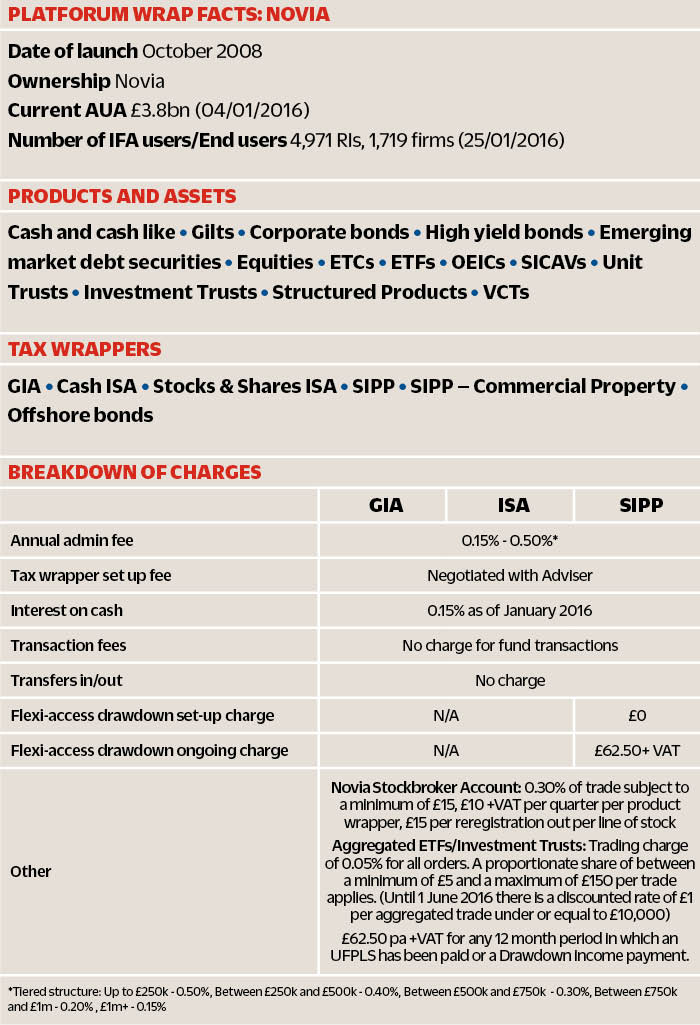
Novia has stolen a march on many of its peers by forging ahead with bringing discretionary fund managers onto its platform. It offers access to a wide range of DFMs: currently 60 and counting. In this week’s platform focus, we take a look at why it has been so successful in attracting DFMs and what steps it is taking to realise chief executive Bill Vasilieff’s ambition of offering the best investor experience in the market.


Novia’s assets under administration grew by 25 per cent year-on-year (as at Q3 2015) although from a smaller base. It now stands at £3.8bn.


The feedback we hear from advisers is that Novia is easy to work with and gets some important things right. For example, those looking for access to a wide range of on-platform model portfolios should be attracted by the choice available on Novia.


DFMs we have spoken to find the platform easy to work with. They say it makes it easy for them to get paid and its sales team works with them to help attract new business into their model portfolios. Novia also operates its own DFM, Copia Capital Management.


The wide range of collectives, asset classes and instruments available on-platform also makes Novia well suited to facilitating DFMs’ model portfolios. The platform tells us it has seen ETF use grow rapidly, albeit from a small base. It has just announced a deal with Winterflood to use its new trading system to improve access to ETFs for its users. Winterflood’s automated service trades can cost as little as £1 (although advisers should also consider the spread between bid and offer prices for small trades).


Novia has also been investing in updates to its tools and technology, with a move to version 12 of the core administration system provided by GBST coming up.


Our user scores for the platform’s web usability, usefulness of online tools and ease of doing business have been dipping, so it is encouraging to see it is taking action to address this.


There is a new look Investor Zone, which looks clean with clear and simple graphics and charts. It is now tablet friendly and provides e-delivery of half-yearly statements. Previous statements will also be archived online. The next phase is to put contract notes online as well. Advisers tell us they want paperless systems, so it is good to see Novia taking note. We have been impressed by the updates to the platform’s Model Portfolio Manager, a tool that can be used by advisers and DFMs alike. Novia trains all adviser firms to use Model Portfolio Manager, as it enables rebalancing. Advisers can link clients to models and DFMs can load specific models against specific advisers. It also prohibits using net funds if a gross fund is available on-platform, ensuring the most tax efficient route is taken. We were particularly taken with its database of corporate actions, which are automatically flagged and therefore helpful for advisers needing to notify clients.


Novia’s book price ranges from a modest 0.15 per cent for portfolios of £1m-plus, to a punchy 0.5 per cent for portfolios of up to £250,000. With average platform charges settling at around 0.35 per cent this suggests to us Novia is focused on attracting investors with portfolios in excess of £250,000: a rarefied pool indeed. Novia must articulate its value to these investors and their advisers. New business is a clear focus and this group of investors is sought after. Other platforms will be circling.


Chief executive Bill Vasilieff tells us his ambition is to make Novia’s investor experience the best in the market. Its recent investment in technology combined with its comprehensive range of funds and instruments shows it is making the right moves. However, some of the advantages Novia has over less-nimble rivals will fade in time.


The challenge will be to continue to innovate to be able to maintain its lead.


Miranda Seath is senior researcher at Platforum